
Can a Simple Wrist Test Actually Reveal Your Body Type? Separating Somatotype Myths From Fitness Reality
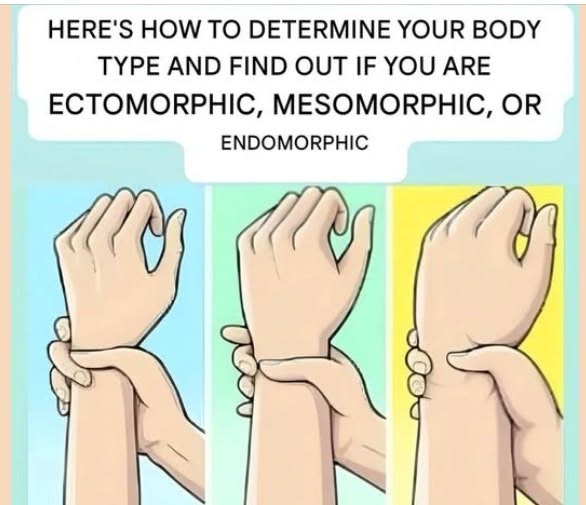
Social media fitness feeds frequently feature quick, visual self-assessments that promise to decode your physiology in seconds. One of the most popular viral trends is the wrist test—a simple trick where you wrap your thumb and middle finger around your opposite wrist to determine whether you have an ectomorphic, mesomorphic, or endomorphic frame.
According to these popular charts, if your fingers overlap easily, you are an ectomorph; if they barely touch, you are a mesomorph; and if there is a wide gap between your fingers, you are classified as an endomorph.
While the concept of body types is a foundational part of fitness history, using a quick finger-wrap around your wrist is more of a fun internet parlor trick than an accurate scientific diagnostic tool. Understanding the real history of somatotypes, what your bone structure actually dictates, and how to train for your true physiology helps cut through fitness misinformation.
Where Did Ectomorphs, Mesomorphs, and Endomorphs Come From?
The classification of human body types into ectomorphs, mesomorphs, and endomorphs is known as the somatotype system. However, it did not originate in modern exercise science or medicine.
The system was developed in the 1940s by an American psychologist named William Herbert Sheldon. Interestingly, Sheldon was not trying to design workout plans or diet regimens; instead, he was attempting to classify human physiques to study temperament and personality traits—a discredited pseudo-scientific field called constitutional psychology.
Sheldon rated individuals on a 7-point scale across three physical extremes:
- Ectomorphy: Characterized by linearity, thinness, and fragility.
- Mesomorphy: Characterized by muscularity, hard bone structure, and an athletic build.
- Endomorphy: Characterized by roundness, softness, and a tendency to store excess fat.
Decades later, exercise scientists and the fitness industry adopted the somatotype labels as a convenient shorthand to describe general body shapes. However, modern kinesiologists emphasize that human genetics are vastly too complex to fit neatly into three rigid boxes.
Does the Wrist Test Actually Work?
The wrist test relies on measuring your bone structure, specifically your wrist circumference relative to your height (sometimes used in clinical settings to estimate frame size, such as small, medium, or large).
While wrist size does give a rough indication of your overall skeletal frame size, it cannot accurately predict:
- Your metabolic rate.
- How easily you build muscle mass.
- How your body stores and burns fat.
- Your optimal nutrition or training split.
A person with a small skeletal structure (narrow wrists) can still carry significant body fat if they consume a caloric surplus, just as someone with a broader skeletal frame can build a lean, low-body-fat physique through targeted training and nutrition. Treating a wrist measurement as a definitive guide to your athletic potential overlooks lifestyle, hormones, consistency, and training history.
What Your Real Body Type Means for Fitness
While rigid somatotypes are scientifically oversimplified, most people naturally lean toward one of three general physical tendencies. Understanding these tendencies can help you tailor your training and nutrition more effectively.
1. The Lean and Slender Tendency (Ectomorph-Leaning)
Individuals who struggle to gain weight or build muscle mass typically possess lighter bone structures, faster metabolisms, and slender limbs.
- Fitness focus: To build strength and muscle, focus on progressive overload with compound weightlifting movements (squats, deadlifts, presses), eat a slight caloric surplus, and keep excessive high-intensity endurance cardio in check.
2. The Naturally Athletic Tendency (Mesomorph-Leaning)
People with this predisposition build muscle relatively easily, maintain a moderate body fat percentage without extreme effort, and respond well to varied training styles.
- Fitness focus: A balanced routine combining strength training, agility work, and moderate cardiovascular exercise yields great results. Consistency remains key, as caloric surplus can still lead to fat gain over time.
3. The Solid and Sturdy Tendency (Endomorph-Leaning)
Individuals with broader frames often find it very easy to gain weight (both muscle and fat) and must work harder to lean out due to a more efficient energy-storage metabolism.
- Fitness focus: Incorporating regular cardiovascular training (zone 2 cardio and HIIT) alongside full-body strength training helps manage energy balance. Prioritizing protein intake and monitoring caloric density in food choices supports sustainable fat loss.
Why Rigid Labeling Can Hold You Back
One of the biggest pitfalls in modern fitness culture is using body-type labels as a fixed identity or an excuse. Hearing someone say, “I’m an endomorph, so I can never lose weight,” or “I’m an ectomorph, so I’ll never get strong,” creates a psychological barrier that discourages progress.
Human genetics are a spectrum, not a category. Most people display a hybrid combination of traits—such as an ectomorphic upper body with endomorphic fat distribution in the lower body, or a mesomorphic build that has adapted to a sedentary lifestyle. Your current physical condition is a reflection of your past habits, nutrition, and activity levels, none of which are permanently locked in by the size of your wrists.
Frequently Asked Questions
Can your body type change over time?
Yes. While you cannot alter your underlying skeletal frame size, your body composition (the ratio of muscle mass to body fat) changes dramatically based on your diet, exercise habits, stress levels, hormones, and aging. Many people transition through different physical shapes throughout their lives.
Is the wrist test completely useless?
Not entirely. Measuring your wrist circumference is sometimes used in nutrition formulas to estimate frame size for calculating healthy weight ranges or Body Mass Index (BMI) baselines. However, it is useless for determining your workout routine or metabolic health.
Do different body types require completely different diets?
While macro splits can be tweaked based on your goals (such as higher protein for muscle building or controlled carbohydrates for fat loss), the fundamental laws of energy balance apply to everyone. Weight management always comes down to caloric intake versus expenditure, regardless of your somatotype label.
How can I know my true fitness potential if somatotypes are outdated?
Instead of taking online quizzes or wrist tests, focus on measurable performance metrics: how much weight you can lift safely, your cardiovascular endurance, your energy levels, and how your clothes fit. Tracking progressive performance is a far more reliable guide than trying to fit your body into a 1940s psychological category.