Put Your Observation Skills to the Test: Can You Find All the Hidden Cats?
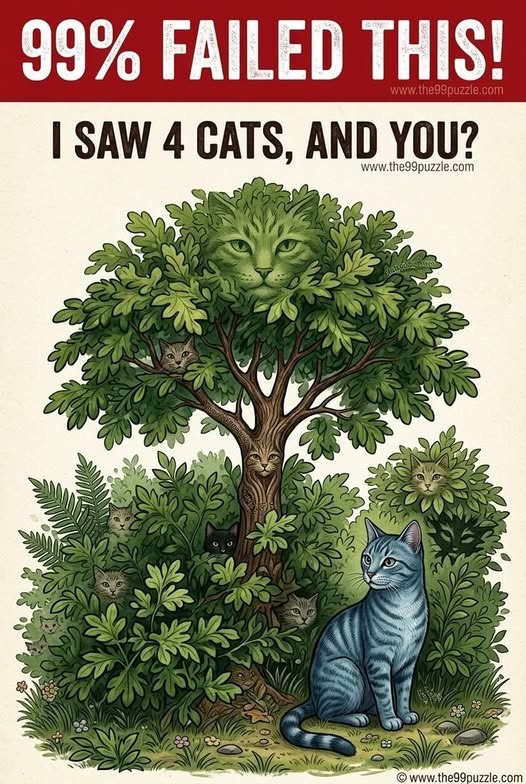
Visual puzzles and optical illusions have a unique way of capturing our attention, challenging our brains to look past the obvious and notice subtle details. The image in image_60505f.jpg presents a classic brain teaser: while a prominent blue-gray cat sits clearly in the foreground, the entire scene is actually teeming with cleverly concealed feline faces hidden among the leaves, branches, and bushes.
The Appeal of Visual Puzzles
Brain teasers and hidden-object challenges stimulate cognitive function, improve visual scanning skills, and provide a fun mental break from routine tasks.
- Mindfulness and Focus: Searching for hidden details requires deep concentration, temporarily clearing the mind of daily distractions.
- Pattern Recognition: Our brains naturally search for familiar shapes—like cat ears, eyes, and whiskers—hidden within natural patterns like foliage and tree bark.
If you are interested in exploring more ways to keep your mind sharp and test your cognitive skills, you might find it useful to read our guide on how visual puzzles and brain games boost cognitive agility.
Breaking Down the Hidden Cats
If you look closely across the tree canopy, trunk, and surrounding bushes, you will find a surprisingly high number of cats cleverly blended into the artwork:
- The Canopy Masterpiece: At the very top of the tree, the upper foliage forms the shape of a massive green cat’s face.
- Branches and Trunk: Smaller feline faces are subtly integrated into the left branch, the center of the tree trunk, and lower bushes.
- The Foreground and Foliage: From the black cat peeking out near the center trunk to the various hidden kitten faces nestled deep within the fern leaves on the left and right, there are far more than just the four cats mentioned in the prompt text!
If you enjoy testing your limits with challenging visual tests, our resource on advanced optical illusions and how to solve them quickly offers great tips and tricks.
Comparison: Quick Glance vs. Detailed Inspection
| Viewing Approach | What You Notice | Challenge Level |
| Quick Glance | The large blue cat and the main tree canopy | Easy |
| Detailed Inspection | Hidden faces in the leaves, trunk, and bushes | Hard (99% fail!) |
Common Misconceptions
A common mistake when tackling these puzzles is scanning the image too quickly and only counting the obvious animals in the foreground. True hidden-object illustrations often use camouflage and negative space, requiring a systematic grid-by-grid search to uncover every secret.
- Fact: Optical illusions play on our tendency to focus on high-contrast elements while ignoring low-contrast camouflage patterns in the background.
When to Take a Mental Break
While brain teasers are a fantastic way to pass the time, staring at high-detail images for too long can cause eye fatigue. Taking short breaks to rest your eyes ensures you stay sharp during complex visual challenges.
To learn more about maintaining eye health and focus during screen-heavy tasks, check out our guide on effective strategies to reduce eye strain and visual fatigue.
Conclusion
Puzzles like the one in image_60505f.jpg prove that things are rarely as simple as they first appear. Whether you spotted a handful of cats right away or had to search every corner of the image to find them all, these brain teasers offer a delightful test of patience and perception. How many did you manage to find?
FAQ
1. How many cats are actually hidden in the image? While the text mentions four cats, a meticulous search across the leaves, branches, and bushes reveals over ten hidden feline faces and silhouettes!
2. Why are optical illusions so effective at hiding objects? They use camouflage, matching color palettes, and Gestalt principles of perception to blend distinct shapes into larger background patterns.
3. Do brain teasers improve concentration? Yes, regularly engaging in visual puzzles helps train your brain to notice small details and improves focus.
4. What is the trick to solving hidden object puzzles quickly? Divide the image into sections (top, bottom, left, right) and scan each quadrant methodically rather than looking randomly.
5. Are AI-generated optical illusions common now? Yes, many modern puzzles utilize advanced AI generation tools to create intricate hidden-object artwork.
6. Can children benefit from solving visual puzzles? Absolutely; they help develop hand-eye coordination, spatial awareness, and visual discrimination skills in kids.
7. Why do people love sharing these challenges on social media? They spark friendly competition, curiosity, and lively discussions in the comments about who found the most hidden items.
8. Where can I find more puzzles like this? There are numerous dedicated puzzle websites and books featuring brain teasers, spot-the-difference games, and hidden-picture challenges.