
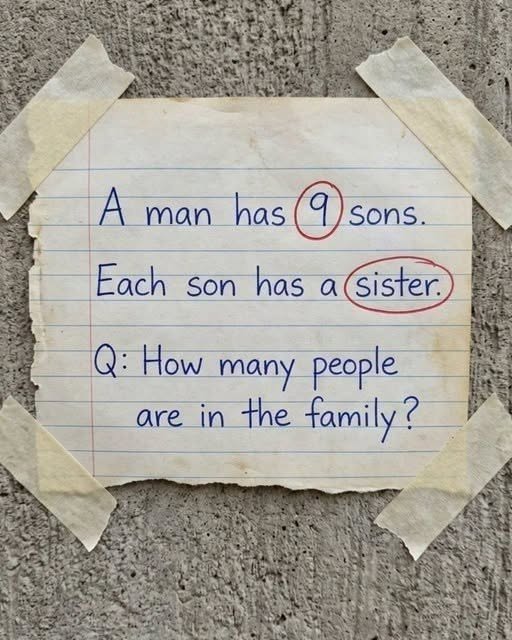
How Many People Are in This Family? Decoding the Classic 9-Sons Riddle
To solve the riddle accurately, every single person explicitly established by the sentences must be counted without adding unmentioned assumptions.
1. Count the Father
The riddle begins with “A man…” That gives us 1 person (the father).
2. Count the Sons
The man has 9 sons. That adds 9 people to the family total ($1 + 9 = 10$).
3. Count the Daughter (The Key Twist)
“Each son has a sister.” Because all nine boys belong to the same family, having 1 daughter means every single one of the nine brothers has a sister. That adds 1 person to the family ($10 + 1 = 11$).
The Final Answer: There are 11 people in the family (1 father + 9 sons + 1 daughter). (Note: Some variations of the riddle include a mother for a total of 12, though strictly based on the text provided, only 11 individuals are confirmed.)
What Word Riddles Teach Us About Careful Thinking
Brain teasers and logic puzzles are far more than entertaining social media distractions—they serve as practical workouts for critical thinking and reading comprehension.
- Slowing Down Automatic Thinking: Puzzles force you to shift from fast, intuitive guesswork to deliberate, analytical reasoning.
- Precision in Language: Subtle words like “a” versus “their own” completely change the mathematical reality of a statement.
- Cognitive Flexibility: Practicing lateral thinking trains your brain to question initial assumptions when solving real-world problems.
Key Takeaways
- The Correct Total: Strictly following the text, there are 11 people in the family—the father, 9 sons, and 1 shared daughter.
- The Common Mistake: Multiplying $9 \times 2$ assumes every son has a different sister rather than sharing one sibling.
- Mental Exercise: Word riddles expose cognitive shortcuts and encourage slower, more careful reading.
Frequently Asked Questions
Why is the answer 11 and not 19?
Because all 9 sons are brothers in the same family, they share the same single sister. Adding 1 father, 9 sons, and 1 daughter equals 11 people.
Could the answer be 12 if you count the mother?
In strict logic puzzles, you only count individuals explicitly mentioned or directly implied by the prompt. Since a mother is not mentioned in the riddle, 11 is the standard answer, though 12 is a common conversational follow-up.
Why do riddles like this go viral on social media?
They combine simple language with a clever linguistic twist, prompting readers to test themselves and debate their answers in the comments.
What skill does this riddle actually test?
Rather than advanced math, this riddle tests reading comprehension, attention to detail, and the ability to avoid impulsive mental shortcuts.
How can I get better at solving word riddles?
Read every word literally, visualize the scenario as a real-life situation, and pause before applying basic arithmetic to words like “each” or “every.”
Pages: 1 2