
The Tragic, Vanishing Act of Kurt Newton: A 50-Year Mystery
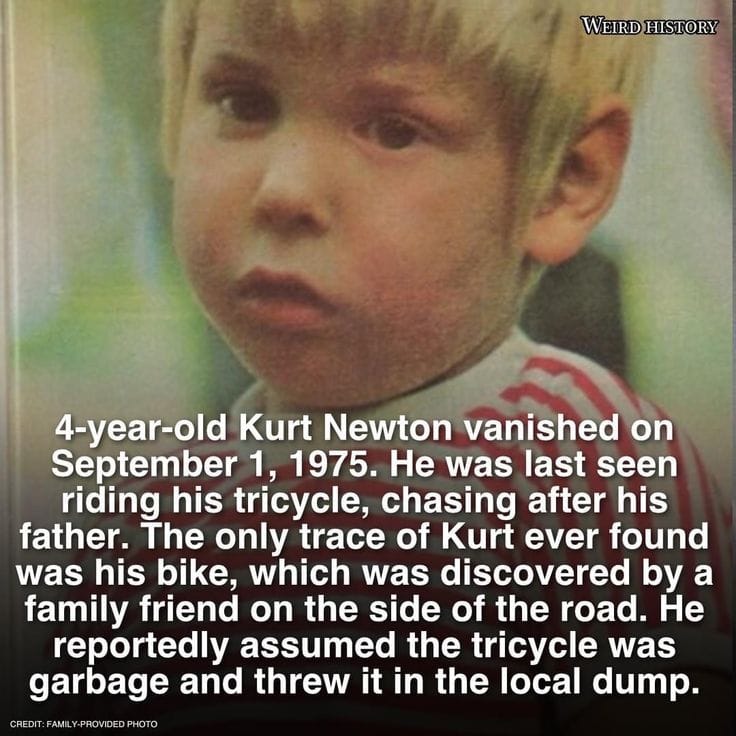
The disappearance of a child is a parent’s ultimate nightmare, but the 1975 vanishing of four-year-old Kurt Newton contains a series of bizarre missteps and eerie details that have baffled investigators for half a century. It remains one of the most haunting and frustrating missing persons cases in Maine’s history.
A Labor Day Getaway Turns to Terror
On September 1, 1975, the Newton family from Manchester, Maine, was enjoying the Labor Day weekend at the Natanis Point Campground in Chain of Ponds—a remote, heavily forested township near the Canadian border.
Kurt’s father, Ronald Newton, set off in his truck to a nearby site to cut firewood. Eager to follow his dad, little Kurt hopped on his prized Big Wheel tricycle and pedaled after him down the campground’s dirt access road.
He was last seen by a family friend, happily chasing after his father’s truck. He was never seen again.
The Fatal Misunderstanding: The Dumped Tricycle
When Ronald Newton returned to the campsite a short time later, the family quickly realized Kurt was missing. A frantic search began, but the family’s hopes were dealt a devastating blow when they learned of a tragic, well-meaning mistake made by a family friend.
Shortly after Kurt had pedaled away, the friend had spotted the boy’s tricycle abandoned on the side of the road, roughly 1.5 miles from the campsite.
- The Fatal Assumption: Because the plastic tricycle was scratched up and dented, the friend assumed it was abandoned garbage left behind by a previous camper.
- The Action: Hoping to keep the campground clean, he loaded the tricycle into his own vehicle and drove it straight to the local dump.
By the time investigators realized the tricycle was actually Kurt’s, crucial physical evidence—such as fingerprints, fabric fibers, or clues indicating whether Kurt had been snatched or had wandered off into the woods willingly—had been completely contaminated or lost at the landfill.
The Tragic Irony: The single piece of physical evidence that could have pointed searchers in the right direction was thrown away within hours of the disappearance.
One of Maine’s Largest Searches Yields Nothing
Once the gravity of the situation set in, the response was massive. The Maine Warden Service, state police, military personnel, and hundreds of civilian volunteers descended upon the remote wilderness.
- The Scale: Over 3,000 volunteers combed the dense, unforgiving terrain.
- The Methods: Searchers utilized tracking dogs, helicopters, and grid-search formations.
- The Conditions: The area surrounding Chain of Ponds was thick with underbrush, bogs, and steep ridges, making the search grueling and perilous.
Despite a week of intensive searching, not a single trace of Kurt Newton was ever found. No scraps of his red-and-white striped shirt, no footprints, and no answers. The tracking dogs picked up a faint scent near where the tricycle was found, but it abruptly ended at the edge of the road, fueling theories that the young boy didn’t wander into the woods, but was instead picked up by a passing motorist.Theories: Lost in the Woods vs. Abduction
To this day, investigators and true crime enthusiasts are split on what happened to Kurt after he left his tricycle behind.
1. The Wilderness Accusation
The prevailing theory held by local authorities is that Kurt simply wandered off the road into the dense Maine woods and succumbed to the elements. A four-year-old could easily become disoriented, and the vast wilderness can swallow evidence quickly. However, experienced woodsmen argue that a child that young rarely travels far enough to completely evade a 3,000-person search grid.
2. A Crime of Opportunity
Because the scent dogs lost Kurt’s trail right at the edge of the road, many believe he was abducted. The campground road was accessible to outsiders, and a lone four-year-old on a tricycle would have been a vulnerable target for a passing predator. If an abduction took place, it means Kurt was likely taken far away from the campground within minutes of disappearing.
An Enduring Legacy of Grief
The disappearance of Kurt Newton deeply scarred the local community and fundamentally changed how missing children cases were handled in the region. Decades later, the case remains officially open, though leads have long since dried up.
Kurt’s parents passed away without ever knowing what happened to their little boy who rode off on his tricycle on a sunny afternoon, chasing after his father, never to return.
