Swansea Jack: The Dog Who Saved 27 Human Lives From Drowning
The Dog Who Did What No Human Could
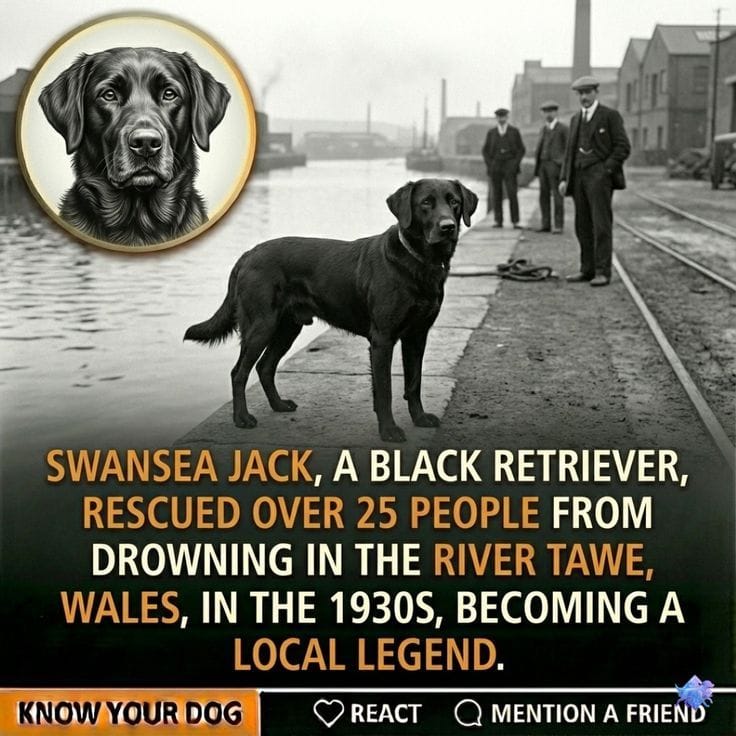
What if a dog saved more lives than most trained rescue professionals ever will? That is not a hypothetical. It actually happened in Swansea, Wales, during the 1930s. A black retriever named Swansea Jack pulled 27 human beings and two other dogs from the brink of drowning — with no training, no commands, and no reward beyond the act itself. By the time he died in 1937, he had become the most decorated peacetime dog in British history and, in the year 2000, was officially named Dog of the Century.
This is his story.
Who Was Swansea Jack?
Swansea Jack was born in 1930 in Swansea, a port city on the southern coast of Wales. He was a black retriever, similar in appearance to a modern Flat-Coated Retriever, though people of the time sometimes identified him as a Newfoundland due to his thick dark coat and powerful build. His early life gave little hint of the legend he was about to become.
As a puppy, Jack was first owned by a man named Taulford Davies. He was, by most accounts, a mischievous dog — known locally for chasing ducks in Llewelyn Park and, oddly enough, for being frightened of the water. He was eventually rehomed and given to William Thomas, who lived in the Padley’s Yard area near the North Dock and the River Tawe. It was there, living beside one of the most treacherous stretches of water in all of Wales, that Jack’s destiny truly began.
The First Rescue: A Boy, A River, and No Witnesses
The date was June 1931. Jack was barely a year old. A 12-year-old boy had slipped near the edge of the North Dock while emptying cinders from a backyard fire and had fallen into the dark river water. The current pulled at him relentlessly. There were no witnesses. No adults nearby. No lifeguards.
Jack heard the boy’s cries, ran to the water’s edge, and without a moment of hesitation, jumped in. He grabbed the boy by the scruff of the neck and dragged him to safety at the dockside. The boy survived. The rescue, with no witnesses present, went unreported. Had things ended there, it might have remained nothing more than a story the boy told to people who never believed him.
But Jack was not done.
The Rescue That Made Him Famous
A few weeks after that first quiet miracle, Jack performed his second rescue — this time in full view of a crowd. A swimmer got into difficulty near Swansea’s West Pier, and Jack dove in again, towed the struggling man to safety, and emerged on the dock as onlookers watched in disbelief. His photograph appeared in the local paper shortly after. The local council awarded him a silver collar. Swansea had found its hero.
From that moment on, Jack’s rescues were no longer private acts witnessed only by those he saved. The city was watching.
Six Years, 27 Lives: How Jack Became a Legend
Between 1931 and 1937, Swansea Jack repeated the same extraordinary act again and again. Whenever he heard cries from the water — whether from the River Tawe or the North Dock — he ran to the edge and jumped in. He grasped victims by their clothing, collars, or limbs and towed them back to the shore or dockside. He did this for children, for adults, for swimmers, and even for sailors. He did it in front of crowds and when no one was looking. He never hesitated.
By the end of his life, the official count stood at 27 human lives saved. He also rescued two dogs, including a sack of puppies he pulled from the water on one occasion. Many who knew him believed the true number of his rescues was even higher — that some incidents simply went unrecorded in the way his very first rescue had.
The waters of the North Dock and River Tawe were considered the most dangerous in Wales at the time. The Swansea docks in the early 1930s were a hub of intense industrial activity driven by the coal trade and metal processing, which drew workers and children alike to the waterfront despite the obvious hazards. Deep, polluted, fast-moving water was a constant threat. Jack lived right beside it, and he treated every drowning person as his responsibility.
The Awards: Britain’s Most Decorated Dog
The recognition that followed was extraordinary for any animal, let alone an untrained dog living in a working-class dockside neighborhood.
Swansea Council awarded Jack a silver collar. The Star newspaper in London gave him the Bravest Dog of the Year award in 1936. He received a silver cup from the Lord Mayor of London himself. He was invited to appear at Crufts, Britain’s most prestigious dog show. His story was covered in newspapers both locally and nationally.
Most remarkably, Jack became the only dog in history to be awarded two bronze medals by the National Canine Defence League — now known as the Dogs Trust. These medals, given in recognition of extraordinary deeds of daring and selfless courage, are the canine equivalent of the Victoria Cross. No dog before or since has received them twice.
His memorial stone, funded by the public of Swansea, carries an inscription that speaks for itself: “Erected to the memory of Swansea Jack, the brave retriever who saved 27 human and two canine lives from drowning. Loved and mourned by all dog lovers. Never had mankind a more faithful friend.”
A Tragic End
For all the lives he saved, Jack’s own ending was neither peaceful nor just. He died on October 2, 1937, after accidentally consuming rat poison. He was seven years old.
The people of Swansea were devastated. The city mourned him as it would have mourned any beloved local figure. A schoolmaster personally funded a small funeral. The sculptor J. Cecil Jones offered at his own expense to create a full memorial stone with a bust of Jack’s head, which still stands today on the Promenade near St. Helen’s Rugby Ground in Swansea.
The Legacy That Lives On
Swansea Jack’s story did not end with his death. In 2000, he was named Dog of the Century by NewFound Friends of Bristol, an organization that trains domestic dogs in aquatic rescue techniques — a nod to how his example had inspired real programs dedicated to canine water rescue.
His legacy shaped community identity in Swansea in lasting ways. People from Swansea have long been nicknamed “Swansea Jacks,” a term rooted in the city’s heritage as a port town. A pub near Swansea City’s former football ground, Vetch Field, was named Swansea Jack in his honor, and in 2025, the club announced the opening of a new sports bar in the city called The Swansea Jack, keeping his name alive for a new generation.
In 2022, two lifelong Swansea friends published a children’s book called The True Tail of Swansea Jack to reintroduce his story to younger readers who had grown up not knowing the name behind the memorial on their city’s promenade.
A BBC feature in 2022 marked the 90th anniversary of his first documented rescue. Historians and animal welfare advocates have continued to reference his story as evidence that dogs do not need formal training to act with heroism — that instinct, empathy, and courage can exist in animals in ways that rival and sometimes surpass human behavior.
Did Jack Understand What He Was Doing?
This is the question that follows every retelling of his story. Did Swansea Jack know he was saving human lives? Did he understand the weight of what he was doing each time he jumped into that dangerous water?
There is no definitive scientific answer, and there may never be. What is documented is this: Jack responded every time to cries from the water. He did not swim to the dock area for recreation or habit when conditions were calm. He responded to distress. He distinguished between a person struggling in the water and ordinary activity around the waterfront. He never had to be commanded. He never hesitated. He never stopped.
Whether that constitutes a conscious understanding of life and death is for philosophers and scientists to debate. What is not debatable is the outcome: 27 people went into the water and came back out because a dog named Jack decided they should.
What Swansea Jack Teaches Us
Swansea Jack was not bred for rescue work. He was not trained. He was not deployed. He was a dog living near a river who heard people in trouble and decided, again and again, to do something about it.
His story challenges the assumption that heroism requires preparation, instruction, or even awareness of one’s own courage. It raises serious questions about animal intelligence, empathy, and the bond between dogs and humans — a bond that, in Jack’s case, was expressed not in loyalty to one person but in a broader, almost universal care for human life.
He is buried on the Swansea Promenade, not far from where the River Tawe still flows. His memorial stands. His name endures. And the 27 people he pulled from the water — and the generations that followed them — owe their lives to a dog who was once afraid of water, then learned not to be.
Key Facts About Swansea Jack
Born: 1930, Swansea, Wales
Breed: Black retriever (sometimes described as a Newfoundland type)
Owner: William Thomas (later in life)
Active rescue period: 1931 to 1937
Lives saved: 27 humans and 2 dogs
Awards: Silver collar from Swansea Council, Bravest Dog of the Year (1936), Silver Cup from the Lord Mayor of London, two bronze medals from the National Canine Defence League (the only dog ever to receive this honor twice)
Cause of death: Rat poison, October 2, 1937
Named Dog of the Century: Year 2000
Memorial: Swansea Promenade, near St. Helen’s Rugby Ground, Swansea, Wales